

Overview
Every vintage vacuum tube has a history. Careful testing helps me understand its condition today.
Tube testing evaluates a tube’s electrical performance, noise characteristics, and overall health. Meaningful test results help buyers understand what they’re getting and choose tubes suited to their equipment.
How I Test at VTubeAudio
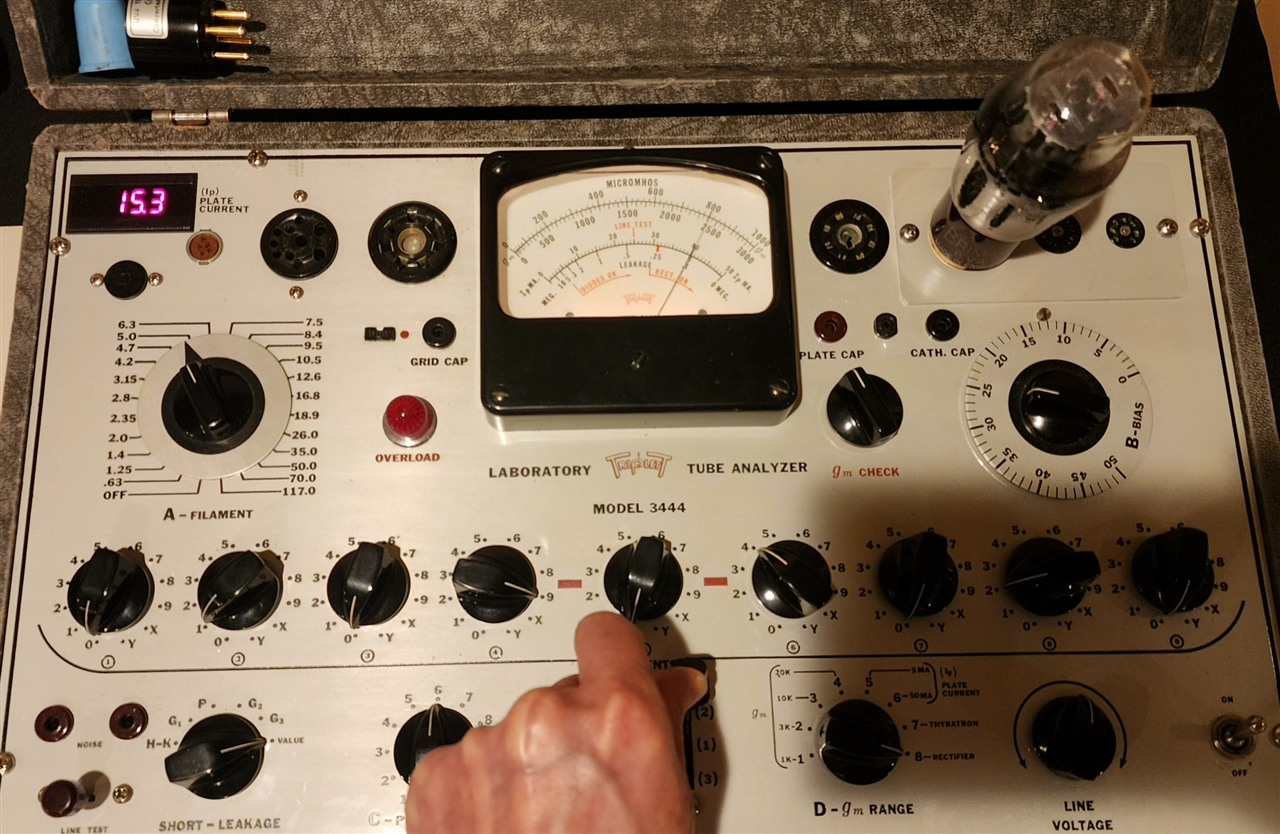
At VTubeAudio, most of my vacuum tubes are evaluated using a restored and calibrated Triplett 3444 Laboratory Tube Analyzer, a highly regarded vintage instrument designed to measure a tube's electrical performance. Selected tubes have also been tested using an Amplitrex AT1000.
Depending on the tube type, I check for shorts and leakage and measure electrical characteristics such as transconductance (Gm) and plate current. For audio tubes, I also perform noise and microphonics checks when appropriate.
Different tubes require different testing procedures. Rectifiers, preamplifier tubes, and power tubes have distinct operating characteristics, and I evaluate them using the appropriate available tests and reference values.
Key Concepts
Transconductance (Gm)
- Measures how effectively a tube amplifies a signal.
- Interpret Gm readings using the appropriate reference values and testing conditions for the tube type.
Plate Current (Ip)
- Indicates how much current the tube draws under load.
- Important for matching and biasing.
Emissions
- Measures the cathode’s ability to emit electrons.
- Low emissions indicate a worn tube.
Noise & Microphonics
- Noise: hiss, hum, crackle
- Microphonics: tube picks up vibration and turns it into sound
- Critical for preamp tubes and hi‑fi systems
Tube Tester Types
My primary instrument is the Triplett 3444 described above. Other tester types you may encounter in tube listings include the following; these examples do not all represent equipment used by VTubeAudio.
Hickok Mutual Conductance Testers
- Industry standard for vintage tubes
- Measures transconductance accurately
B&K & Sencore Testers
- Reliable emissions and shorts testing
- Good for quick health checks
Amplitrex AT1000
- Modern digital tester
- Tests under real operating conditions
- Provides detailed, repeatable results
Orange VT1000
- Simple automated tester
- Good for guitar players and quick checks
Practical Use
- Guitar Amps: Testing helps identify noisy preamp tubes and weak power tubes.
- Hi‑Fi Systems: Testing helps assess channel balance and identify noise.
- Restoration: Testing helps assess a tube’s condition for use in compatible vintage equipment.
How I Match Tubes
When matching tubes, I compare their relevant electrical measurements under the same testing conditions. For dual-triode tubes, I also evaluate the performance of each section. Matching criteria vary by tube type and intended application.
What Buyers Should Look For
- Clear test results
- Tester model used
- Noise/microphonics notes
- Matching values (if applicable)
Test Results With Your Purchase
My audio tube listings include available test measurements, and I provide individual test-result charts with applicable purchases so customers can see how their tubes performed.
What Sellers Should Disclose
- All test values
- Any noise or microphonics
- Whether the tube was tested under load
- Any physical defects
Testing Limits and Disclosure
Some specialized tubes require testing equipment beyond my available capabilities. When this is the case, I clearly disclose what has been tested and what remains unverified.
A Test Result from My Bench
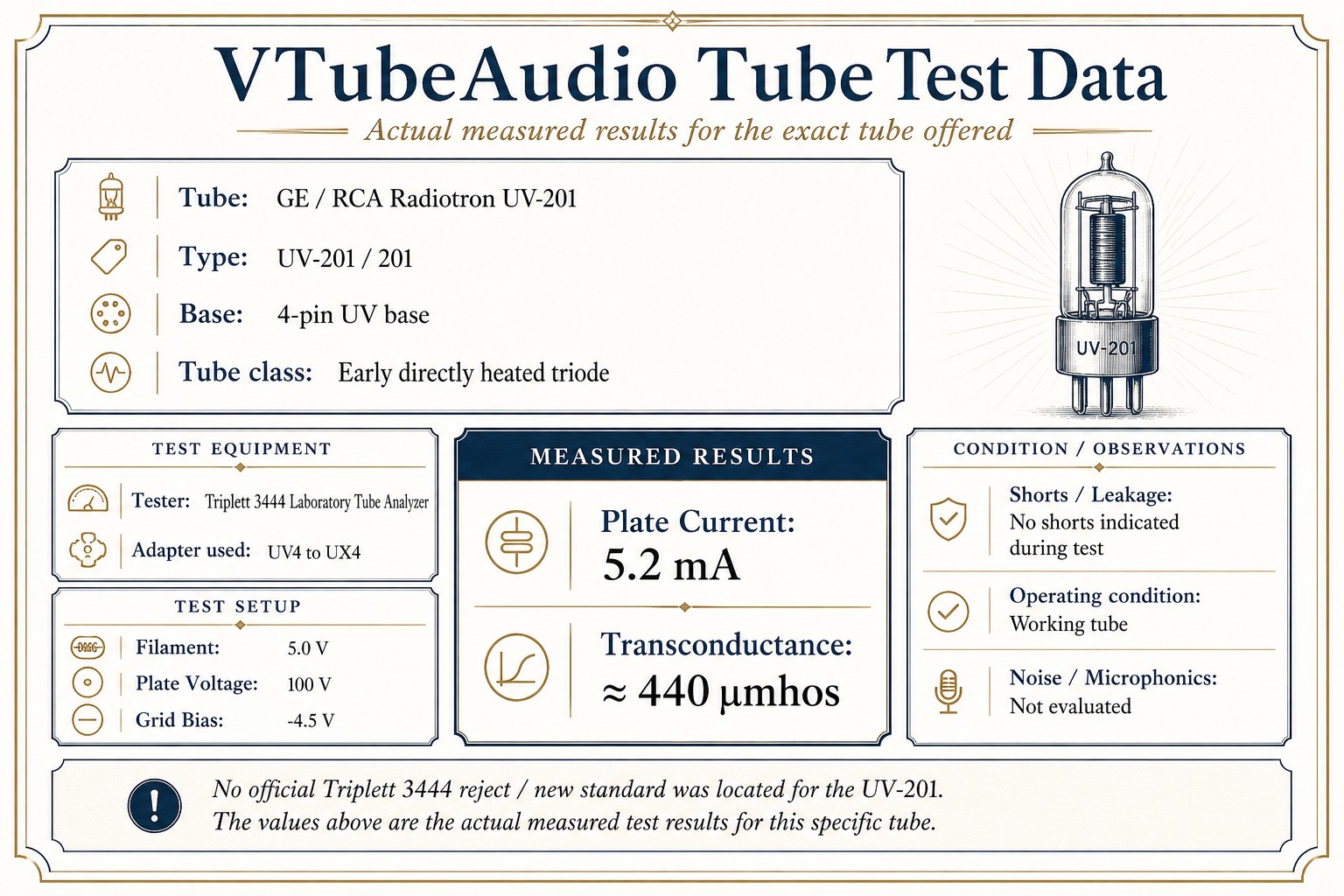
This result card records measurements for one GE / RCA Radiotron UV-201, an early directly heated triode with a four-pin UV base. It shows both the results and the conditions used to obtain them.
| Tester and adapter | Triplett 3444; UV4 to UX4 adapter |
|---|---|
| Filament voltage | 5.0 V |
| Plate voltage | 100 V |
| Grid bias | −4.5 V |
| Plate current | 5.2 mA |
| Transconductance | Approximately 440 µmhos |
| Shorts | No shorts indicated during the test |
| Operating condition | Recorded as a working tube |
| Noise and microphonics | Not evaluated |
No official Triplett 3444 reject or average-new standard was located for this UV-201. These are measurements for this specific tube at the stated settings, not a universal pass/fail threshold or a percentage-of-new grade. The card reports no shorts; it does not give a separate leakage measurement.
The useful lesson is to read the setup, measurements, and limitations together. A result card should make clear what was measured and what was not evaluated.
Summary
Tube testing provides useful information about a tube’s measured condition, performance, and noise. My goal is to help you find the right tube with confidence, backed by accurate descriptions, meaningful test results, and a genuine appreciation for vintage audio.